Improving sustained meaningful participation, restoration and sustained community support for racialized neurodivergent youth in Ontario’s court and custody systems.
Inclusive Justice Collaborative
This collaborative strengthens, connects and builds upon organizations and professionals already working towards better outcomes - addressing systemic gaps and advancing consistency, coordination and standardized practices.
We are building on existing strengths, not starting from scratch.


Central Question
How should our systems change so that neurodivergent youth - especially Black, racialized, and marginalized youth - are understood, supported and able to meaningfully participate in court and custody processes, while receiving restoration, transition support and appropriate long term community support.
Desired Impact
Racialized neurodivergent youth are understood, supported and able to meaningfully participate in decisions affecting their lives - they are treated with dignity, equity and respect - and have real opportunities to communicate, be understood and thrive.
The Problem
Racialized neurodivergent youth are overrepresented in the legal system because schools, services, policing, courts, probation and custody often fail to recognize and accommodate their needs - contributing to legal involvement, repeated contact, and punitive responses that compound harm.
-
Failure to identify and accommodate neurodivergent learning and support needs early.
-
Punitive Environments fail to provide strengths-based support, accommodation, restoration or community connection.
-
Neurodivergent behaviours are misread as non-compliance, leading to escalation and changes that are not well understood.
Theory of Change Presentation
Infographic
1-pager
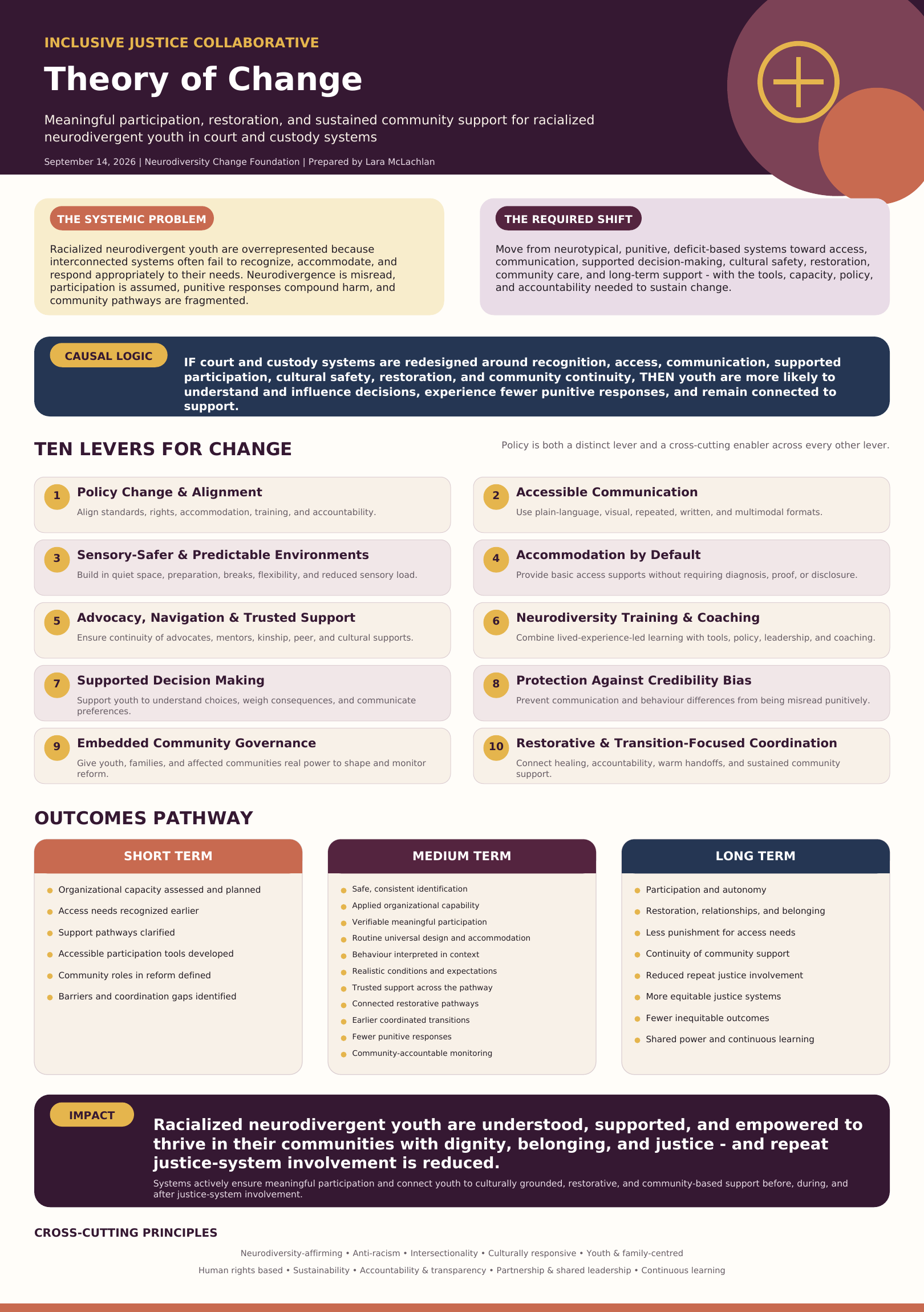
Theory of Change (TOC)
Introduction to Theory of Change
Theory of Change - Inclusive Justice Collaborative
Differences in behaviour can be misread
Sensory overload & Shutdown
Communication differences
Trauma responses & Anxiety
Executive functioning challenges
Unmet access needs
Defiance or disrespect
Dishonestly, lack of remorse
Manipulation, non-compliance
Substance use or intoxication - when this is not the case
Needs are missed. Punitive responses follow.
Levers of Change - Inclusive Justice Collaborative:
-
Revise policies, protocols, eligibility requirements and accountability mechanisms to formalize accessibile communication, standardized intake and assessment, supported participation, continuity of support and culturally responsive practice.
-
Redesign intake and assessment processes to reduce shame and stigma, and recognize needs early.
Create stable and consistent assessment tools to identify strengths, successes, communication needs, support needs, barriers, while accounting for cultural stigma, existing shame, distrust and risks youth feel with disclosure.
-
Consider lighting, sound, temperature, smell and other sensory stimuli.
-
Create consistent points of connection with justice professionals and clear ways for youth to say when they do not understand. Provide plain language explanations, visual and written guides, definitions of legal terms and simple explanations of court rules, roles, expectations and next steps.
-
Accommodation processes that do not require disclosure are ideal.
Lower administrative, communication, diagnostic, geographic, and procedural barriers to intensive youth support courts, justice centres, diversion pathways and advocacy to facilitate accessibility.
Utilize principles of universal design: The 7 principles:
-
Mechanisms to access supported decision-making and advocacy
-
Training, coaching and community partnerships.
Ensuring neurodivergence is not automatically interpreted as a mental health condition, behavioural problem, substance use issue, or lack of capacity.
Proivde sustained training paired with coaching, practical tools, leadership support, policy change reflective supervision and accountability.
Build knowledge and skills to address communication, sensory needs, executive functioning, trauma, credibility bias, stigma and mental health distinctions.
-
Transition and referral pathways, navigation support. Provide a consistent support person, advocate, navigator who maintains contact, checks in regularly, listens without judgment, explains processes, and coordinates access to trusted service providers.
-
Embed youth, family, indigenous, Black and racialized disability - justice leadership in project design, implementation, monitoring and evaluation
-
Within court and custody systems, expand Indigenous-led restorative pathways focused on healing, accountability, and rebuilding relationships to address harm, and build referral and coordination pathways connecting court and custody actors to existing community, school, and health-system supports for earlier identification and smoother transitions — recognizing that upstream systems themselves sit outside this initiative's direct levers of change.
Outcomes Pathway
Infrastructure (Short term)
Capacity to recognize access needs early
Accessible communication tools integrated
Clearer support pathways established
Organizational capacity assessments developed
Community roles defined
Changed Practice (Medium term)
Access needs identified early
Confident and capable organizations
Participation supported and verifiable
Accommodations are universal and routine
Behaviour interpreted with context
Punitive responses reduced
Transformed Outcomes (Longer term)
Meaningful participation and autonomy
Stronger relationships and belonging
Continuity of community support and services
Reduced repeated justice involvement
Reduced inequitable outcomes
Documents
Revised Draft TOC - July 15 2026
Final TOC - Sep 14 2026
Systems Change
a. Introduction to Systems Change
b. Systems Change - Inclusive Justice Collaborative
Original Infographic

Note on Language: Developmental Disability / Neurodivergence
Developmental disability language remains important to funders, policy frameworks, and service systems, and continues to shape access to formal recognition and supports across the broader landscape.
At the same time, this Theory of Change uses “neurodivergent” and “neurodiversity” to reflect youth voice and a broader, evolving conceptual framework that includes autism, ADHD, learning differences, Tourette syndrome, FASD, and other neurodevelopmental differences. Youth consulted for this project said that “developmental disability” terminology can feel deficit-focused and pathologizing.
Traditional developmental disability frameworks have also not consistently captured the experiences of many women, girls, and racialized individuals, contributing to inequities in recognition, assessment, and access to support. Youth identified neurodivergent language as psychologically safer and more conducive to their engagement.
At the same time, “neurodivergent” can refer to a broad umbrella of individuals, which could shift the focus of this initiative more broadly than intended. A separate related point relates to focusing on formal diagnosis only. This is not recommended, based on project materials to date — but the target group needs to remain clearly defined: racialized neurodivergent youth in contact with Ontario's court and custody systems.